



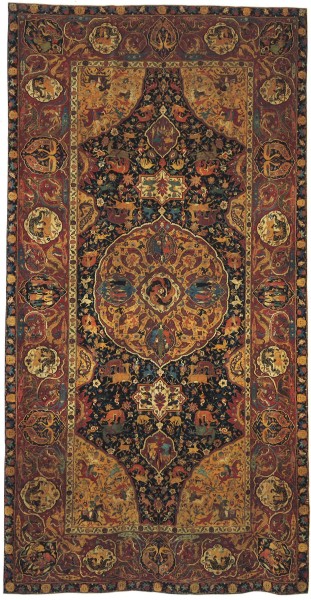
In the quiet mountains of Shiga Prefecture, inside the extraordinary Miho Museum, there is a carpet that seems almost too rich to belong to a single place or time. Known as the Medallion and Animal Carpet, and more widely as the Sanguszko Carpet, this masterpiece is one of the great surviving works of Safavid weaving. It is nearly six meters long and more than three meters wide, yet its power is not only in its scale. Its true force lies in the way it gathers history, movement, animals, myth, paradise, violence, courtly elegance, and political memory into one woven surface.
The Sanguszko Carpet is not simply an antique carpet. It is a painting in pile, a royal object, a survivor of war, and a witness to four centuries of cultural movement. It was woven in Safavid Iran during the 16th or early 17th century, most likely in the atmosphere of a royal workshop. Later it appeared in the Ottoman imperial palace in Istanbul. From there, through the dramatic events of the Battle of Khotin in 1621, it passed into Polish hands and remained with the Sanguszko family for generations. Its later life took it through exhibitions, scholarship, American museum display, and finally to Japan, where it now rests at the Miho Museum.
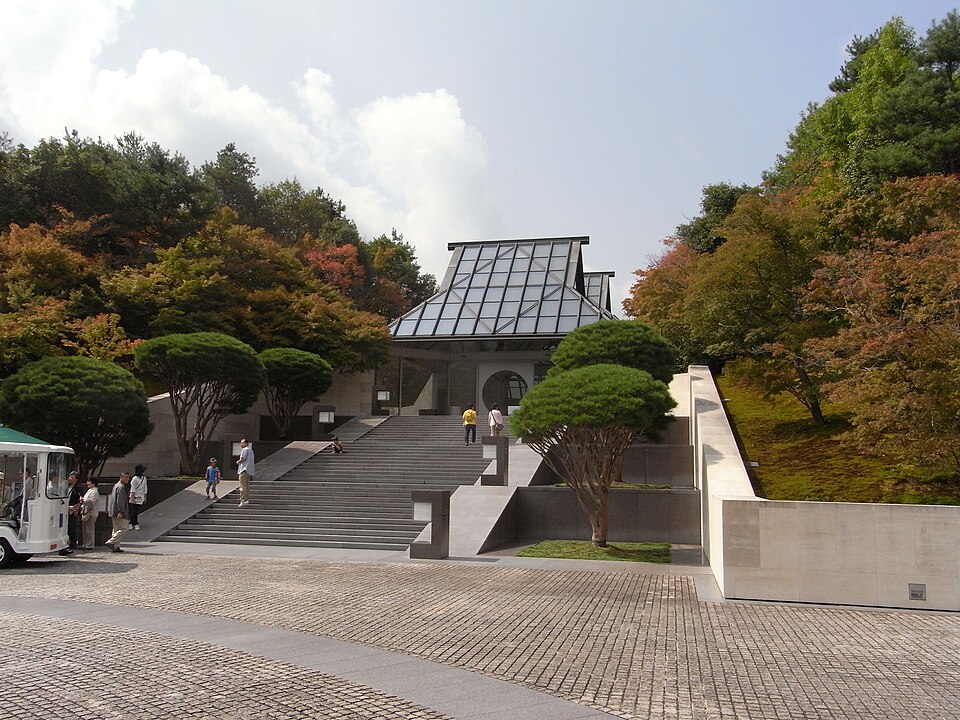
The Miho Museum in Shiga Prefecture. Its secluded mountain setting gives the Sanguszko Carpet a quiet, almost sacred environment, far removed from the imperial courts and battlefields through which the carpet once traveled.
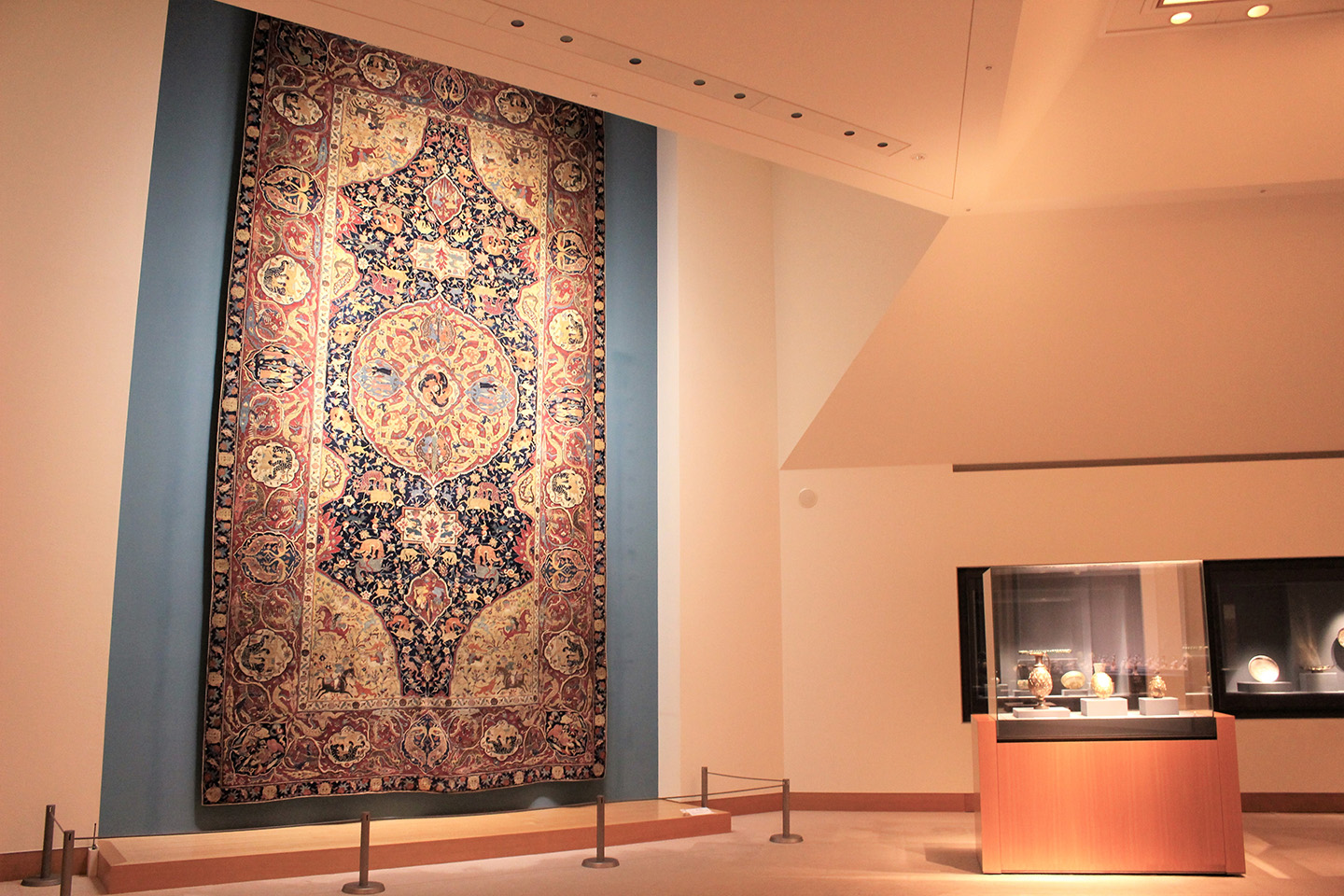
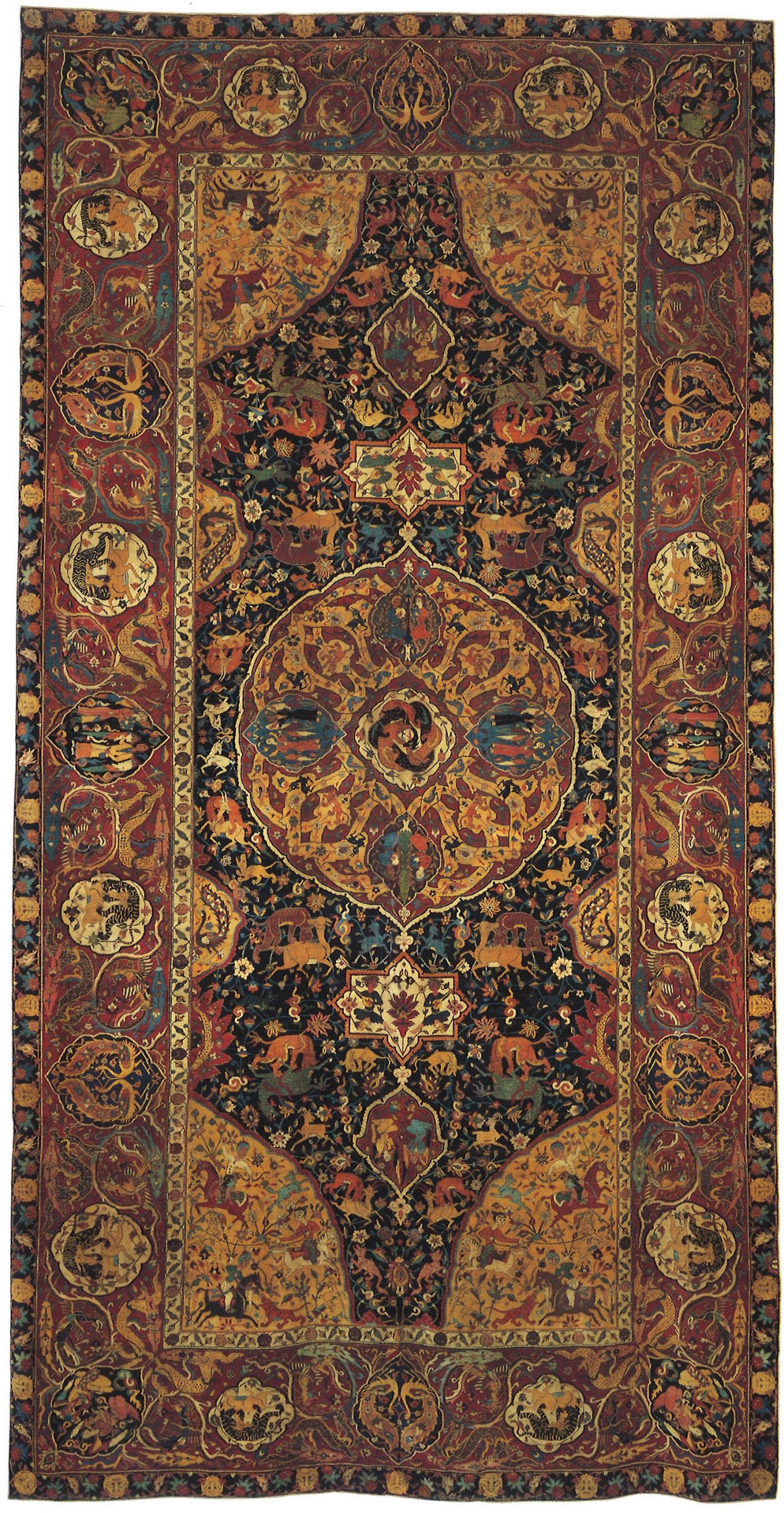
The Medallion and Animal Carpet, known as the Sanguszko Carpet. The composition combines a central medallion, animal combat scenes, paradise imagery, Chinese-inspired mythical creatures, and Safavid courtly refinement.
The carpet belongs to the great artistic flowering of Safavid Iran. During this period, carpet weaving became one of the highest expressions of court culture. The carpet was no longer only a furnishing or a practical object. It became a complete artistic field, planned with the sophistication of manuscript painting and executed by highly skilled weavers.
The central medallion creates order. Around it, however, the world is in motion. Lions attack deer. Birds, peacocks, fish, dragons, phoenixes, qilin, and other real and imagined creatures appear across the field and border. There are also courtly and paradise-related scenes, including figures associated with music, pleasure, and the refined world promised in Islamic imagination.
This is what makes the Sanguszko Carpet so compelling. Its animals are not merely decorative. They carry energy, danger, and symbolic meaning. The battles between animals express life force, protection, cosmic struggle, and royal power. The carpet is peaceful from a distance, but dramatic when studied closely. Its beauty is not static; it is alive.
The Miho Museum catalogue describes how the design contains not only animals from the natural world, but also mythical creatures that entered Islamic art through cultural exchange with Central and East Asia. In Safavid hands, these motifs were transformed into something distinctly Persian: a courtly universe where paradise, power, and movement exist together.
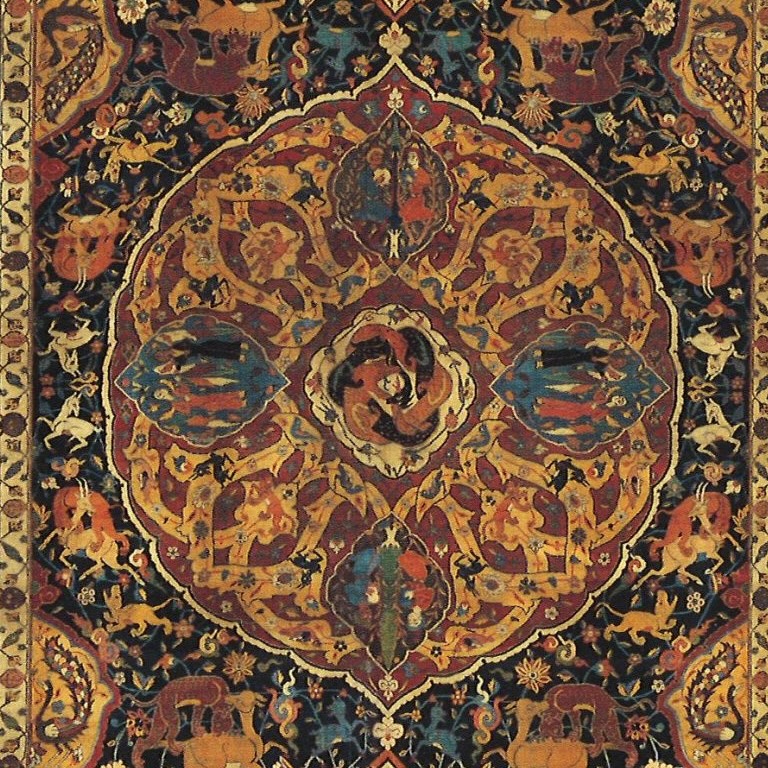
The central medallion establishes the formal order of the carpet. Within and around it, paired dragons and animal combat scenes create a tension between symmetry and movement.
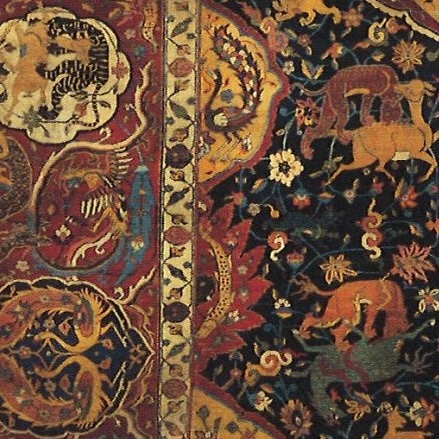
Animal combat imagery was one of the great themes of Safavid carpets. Lions, deer, birds, and mythical creatures transform the surface into a living world.
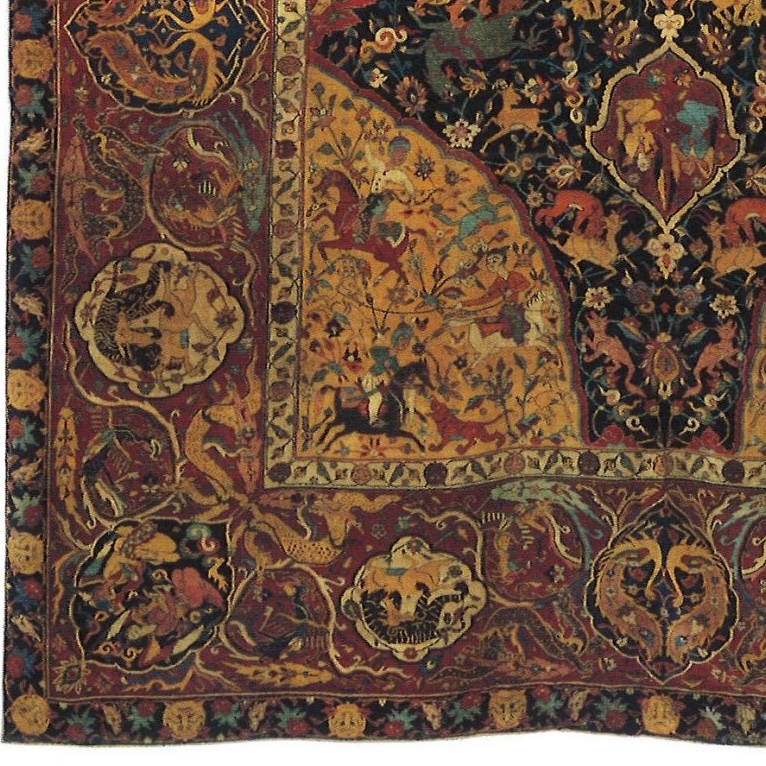
The wide borders are not secondary. They continue the story, carrying animals, arabesques, masks, and symbolic forms around the central field.
One of the most interesting questions raised by the Sanguszko Carpet is the presence of images. Islamic art is often associated with abstraction, calligraphy, geometry, and the avoidance of figural representation, especially in religious contexts. Yet this carpet is filled with animals, courtiers, paradise figures, and dramatic scenes. At first, this may appear contradictory. In reality, it reveals the complexity of Islamic visual culture.
The Sanguszko Carpet was not made for a mosque. It belonged to the world of courts, palaces, diplomatic display, and elite patronage. In such contexts, Safavid artists freely used figural and animal imagery, drawing from Persian poetry, royal hunting culture, miniature painting, paradise symbolism, and older Iranian traditions. The carpet therefore shows a different side of Islamic art: not the abstract language of sacred architecture, but the rich narrative language of royal culture.
This is also where Safavid and Anatolian approaches differ. Many Anatolian carpets and kilims express meaning through geometric motifs, repetition, abstraction, and inherited tribal symbols. Their language is powerful because it reduces the world into signs. Safavid court carpets, by contrast, often expand the surface into a pictorial universe. They do not simply symbolize; they describe, animate, and stage a world. One tradition speaks through abstraction. The other speaks through image, movement, and controlled narrative.
From Safavid Iran to Istanbul, from the Ottoman court to Poland, and later through Europe and America before reaching Japan, the Sanguszko Carpet followed an extraordinary historical route.
The journey of the Sanguszko Carpet is one of the most fascinating stories in the history of carpets. The Miho Museum notes that after being woven in a royal workshop, the carpet was in the palace of the Ottoman emperor in Istanbul by 1621. That same year, during the Battle of Khotin, the Ottoman forces were defeated by the Austro-Polish army. The carpet was taken as war booty and brought into the possession of Prince Sanguszko of Poland.
From that point, the carpet became more than a Safavid court object. It became a European aristocratic treasure. It remained with the Sanguszko family and later emerged into public view in 1904, when it was first exhibited in St. Petersburg. In 1931, it appeared at the International Exhibition of Persian Art in London, where it caused great excitement. Arthur Upham Pope, one of the major figures in the study and promotion of Persian art, recognized its importance and kept it on long-term loan exhibition for many years.
In 1949, the carpet was displayed during the visit of the Shah of Iran to Pope’s Asia Institute in New York. Later, when the Institute closed, Pope advised Prince Roman Sanguszko to place the carpet on loan to The Metropolitan Museum of Art. It remained there until 1995. After centuries of movement, the carpet eventually found a permanent home at the Miho Museum in Japan.
This is why the word “pilgrimage” feels appropriate. The carpet did not simply change owners. It moved through empires, courts, wars, exhibitions, museums, and scholarly rediscoveries. Each stage added another layer to its identity. A Safavid royal carpet became an Ottoman possession, a Polish war trophy, a European family heirloom, an object of scholarly fascination, an American museum treasure, and finally a masterpiece preserved in Japan.
There is another remarkable connection with Japan. Arthur Upham Pope noticed that a design on the war vest associated with Toyotomi Hideyoshi, made from an Iranian flatweave, appeared to come from the same design source, or cartoon, as the Sanguszko Carpet. This means that two objects connected to the same artistic world — one a great pile carpet and the other a textile associated with a Japanese warlord — have, in a sense, met again in Japan after centuries of separation.
At Ararat Rugs, the Sanguszko Carpet is not only an object of admiration. It belongs to a language we continue to study and reinterpret. Our work with Kerman, Safavid, Tabriz, and animal-design carpets comes from the same respect for historical sources, but our aim is not mechanical reproduction. We are interested in how these old designs can breathe again through hand-spun wool, natural dyes, careful drawing, and the human irregularity of hand weaving.
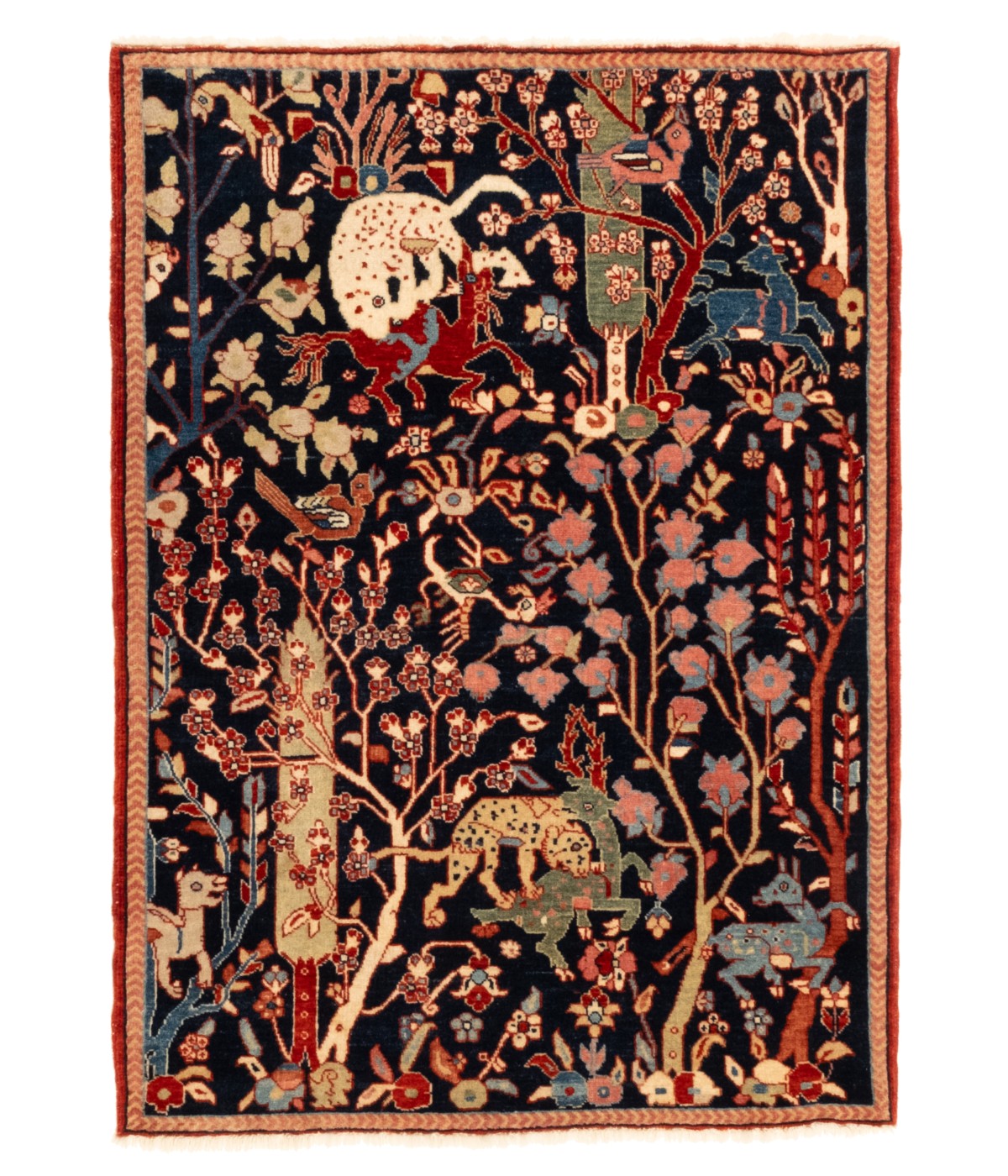 ART00788 — Safavid Tabriz Carpet
ART00788 is a small-format Safavid Tabriz carpet, measuring 88 × 120 cm. Its importance lies in its ability to carry the feeling of a museum fragment into a contemporary handwoven piece. Like many Safavid designs, it depends on rhythm, drawing, and controlled ornament rather than empty space. In the context of the Sanguszko Carpet, ART00788 represents the intimate side of court design: a concentrated study of form, color, and historical memory.
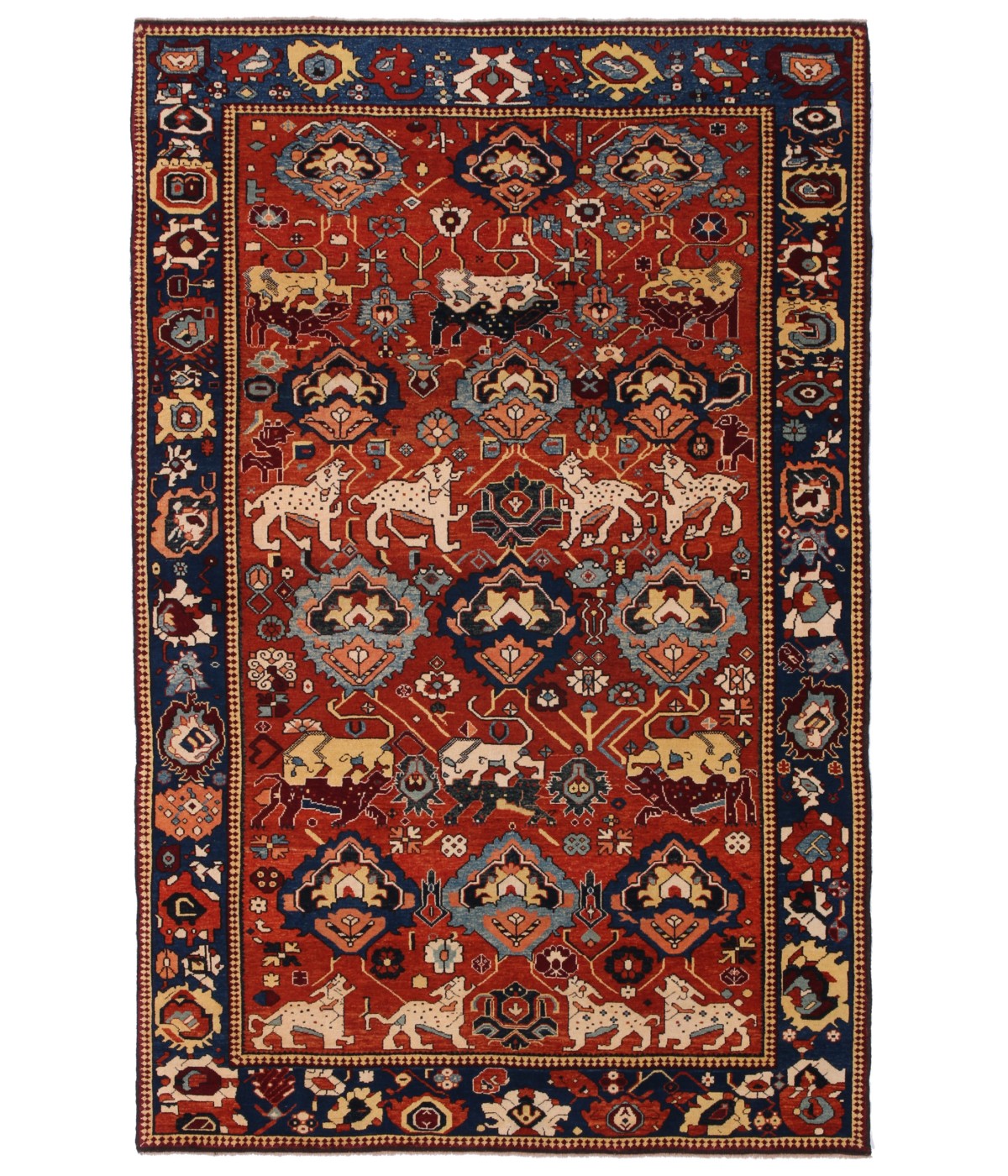 ART00289 — Animal Carpet in a Safavid Design
ART00289, measuring 145 × 219 cm, is directly connected to the animal-carpet tradition. Its source comes from Orient Star - A Carpet Collection, published by Hali Publications. This piece allows us to explore one of the most fascinating subjects in Safavid weaving: the animal as a bearer of movement, conflict, and symbolic force. In such works, the carpet surface is no longer passive. It becomes a stage where life and struggle unfold.
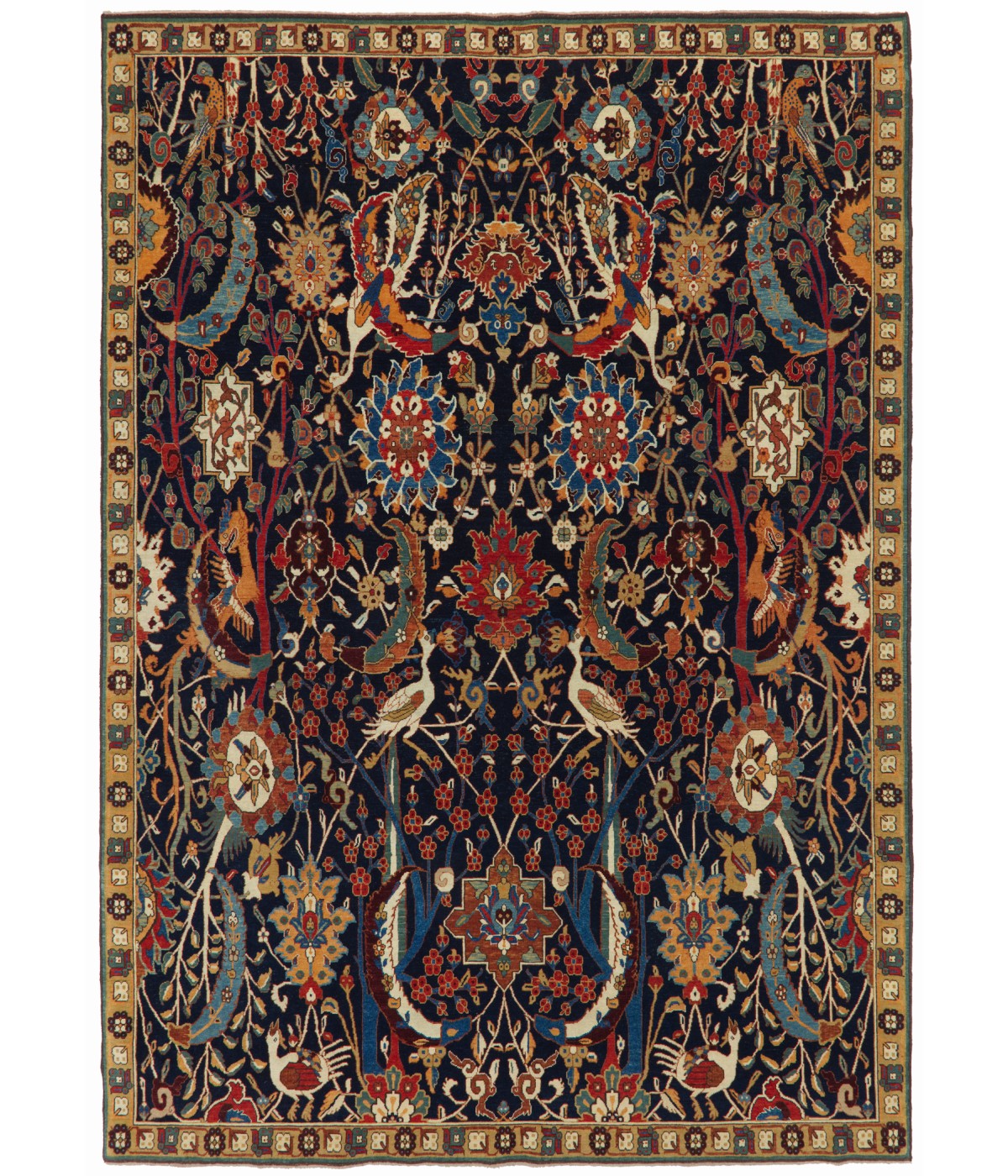 ART00675 — Kerman Vase Carpet
ART00675, measuring 298 × 210 cm, belongs to our Kerman vase-carpet line and is inspired by the famous Kerman vase carpets associated with the Alice de Rothschild Collection. The Kerman tradition is central to understanding the Sanguszko group. Its refined arabesques, floral movement, and sophisticated drawing reflect the same Safavid courtly world in which carpets were designed not only as floor coverings, but as complete visual compositions.
The animals in these carpets are never innocent decoration. A lion attacking a deer may suggest royal strength, but also the cycle of life. A dragon or phoenix may carry echoes of China, Central Asia, and the wider visual exchanges of the Silk Road. Peacocks, fish, and birds can suggest auspiciousness, beauty, and paradise. In the Sanguszko Carpet, all of these meanings overlap.
This is also why animal carpets remain so powerful today. They are not simply historical images. They allow us to feel the old world’s imagination: a world where power, protection, paradise, and danger could all be woven into one surface.
The Sanguszko Carpet matters because it refuses to be reduced to a single category. It is Persian, but it passed through Ottoman and Polish history. It is Islamic, yet filled with figures and animals. It is a carpet, yet behaves like a painting. It is symmetrical, yet full of movement. It is historical, yet still alive to the eye.
This is the kind of work that reminds us why carpets are among the most complete art forms ever created. They combine architecture, painting, textile, color, memory, and human labor. They are made to be lived with, but some of them become greater than use. They become carriers of civilization.
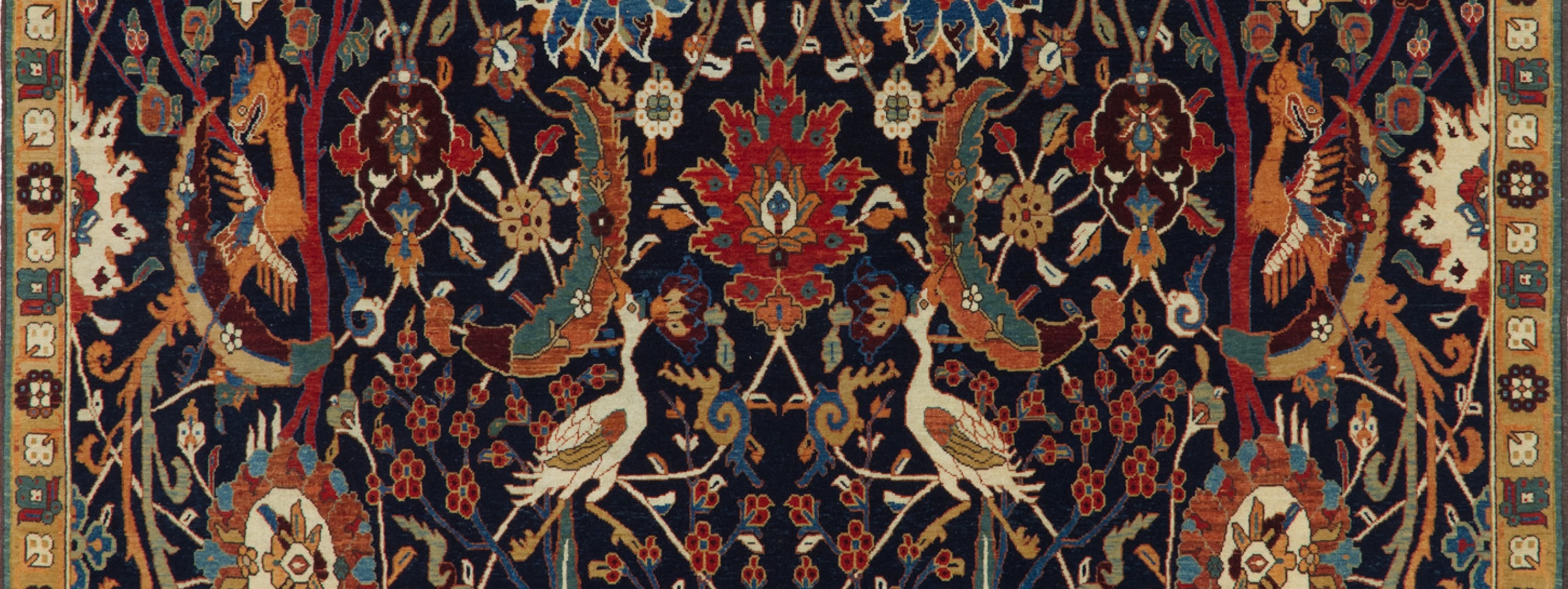
At Ararat Rugs, historical designs are studied not as fixed patterns, but as living languages. Through natural dyes, hand-spun wool, and hand weaving, Safavid and Kerman traditions continue in a contemporary workshop setting.
The Sanguszko Carpet began as a product of Safavid artistic confidence. It passed into the Ottoman world, crossed into Poland through war, entered the imagination of European collectors, became a subject of modern scholarship, and finally found a quiet home in Japan. Across this long journey, it never lost its authority.
-''For us, its story is deeply moving because it shows what a carpet can become. A carpet may begin on a loom, but it does not end there. It travels through homes, courts, collections, museums, and memory. It gathers meaning with every generation.
At Ararat Rugs, this is the spirit we continue to pursue. Not simple reproduction, but continuation. Not nostalgia, but living tradition. The Sanguszko Carpet reminds us that a true carpet is never only woven. It is carried through time.'' - Hakan KARAR